
How Schools Can Fund Creative Technology Programs Through STEM and CTE
Summary
STEM funding is no longer one simple bucket schools can rely on for every technology program. As CTE pathways evolve, creative tech programs now connect across multiple career clusters. Schools can still fund these programs, but they need to lead with outcomes like workforce readiness, career exploration, technical skill development, student engagement, and certification preparation.
STEM funding used to feel like a clear bucket. If a school wanted to fund robotics, coding, engineering, game design or other technology programs, “STEM” often became the starting point. But that has changed.
As career and technical education continues to evolve, creative technology programs now sit across multiple career clusters.
Game design, media production, cybersecurity, AI, digital arts, broadcasting and interactive media do not always fit into one category. But the opportunity is still there. The key is knowing how to position your program, what outcomes to focus on, and how to separate funding needs across curriculum, equipment, and certifications.
Why STEM Funding Changed
STEM worked as a broad category for many technology programs for many years. Schools could often connect game design, coding, robotics, media, and engineering to STEM funding.
Now, those programs are spread across more specific career areas. Creative technology programs often connect to career clusters like Arts, Entertainment, and Design and Digital Technology.
Some examples:
A game design course is not just “STEM.” It can support computer science, digital arts, interactive media, storytelling, design thinking, project management, and workforce credential preparation.
A media production course is not just “video.” It can support broadcasting, communication, digital storytelling, audio and visual technology, marketing, and portfolio development.
A cybersecurity course is not just “IT.” It can support digital safety, network systems, infrastructure, privacy, and technical certification preparation.
The more clearly you connect your program to those outcomes, the easier it becomes to match it with the right funding source.
How Can Schools Fund Creative Technology Pathways?
Schools can fund creative technology pathways by connecting programs to clear outcomes such as workforce readiness, career exploration, technical skill development, student engagement and industry certification preparation. Funding conversations work best when schools explain how the program supports CTE goals, not just what tool or course they want to buy.
In other words, don’t lead with the product. Lead with the outcome.
Grants Fund Outcomes, Not Just Tools
Grants fund outcomes and tools help you reach those outcomes. A grant reviewer usually does not need to hear that students like games. They need to understand what students will learn, how the program supports district goals, and how you will measure success.
So instead of saying: “We want to fund a game design course.”
Say: “We want to build a career-connected digital technology pathway that helps students develop design, programming, collaboration, portfolio, and certification-ready skills.”
Instead of saying: “We need cameras and editing software.”
Say: “We want students to learn the full media production process, including pre-production, production, editing, publishing, and digital portfolio development.”
Instead of saying: “We want cybersecurity curriculum.” Say “We want students to build foundational cybersecurity skills and prepare for industry-recognized certifications tied to entry-level technology careers.”
This type of phrasing makes the program easier to fund because it shows why the investment matters.
Separate Your Funding: Curriculum, Gear, and Certs
Creative technology programs often include several cost areas. Trying to fund everything under one general request can make the process harder.
Instead, separate the program into clear categories:
Curriculum: This covers lessons, projects, teacher materials, pacing guides, assessments, and student-facing learning content. Curriculum funding works best when you connect it to CTE pathways, standards alignment, career exploration, workforce readiness, and measurable student outcomes.
Equipment: This includes student-facing technology such as computers, cameras, microphones, lighting, production gear, networking tools, or lab equipment. The key phrase is student-facing. The equipment should directly support student learning and program outcomes.
Certifications: Certifications help connect the course to workforce readiness. They also give students a clear credential or proof of skill. This matters for CTE programs because many districts want pathways that lead somewhere concrete.
Professional Development: Teachers need support too. Funding can also support training, onboarding, implementation help, or professional development that helps educators deliver the program with confidence.
STEM and CTE Funding Sources for Schools
There is no single funding source for every creative technology program. Schools often need to look across federal, state, local, and foundation opportunities. Here are some programs that you can utilize:
Education Innovation and Research Program (EIR): This program supports new approaches that improve student achievement, especially for high-need students. This can fit programs that use game design, media production, cybersecurity, or AI to teach academic and technical skills in a new way. For example, past EIR awards have supported video game design as a way to teach computer science and STEM concepts.
Small, Rural Schools Achievement Program (SRSA): The Small, Rural School Achievement Program supports rural districts working to improve student academic achievement. For rural schools, creative technology pathways can expand access to courses students may not otherwise have, including game design, media production, cybersecurity, and career-connected learning.
21st Century Community Learning Centers: The 21st Century Community Learning Centers program supports after-school and summer learning. This can be a strong fit for programs that extend learning beyond the regular school day, especially when they focus on career awareness, STEM, visual and performing arts, problem-solving, creativity, and student engagement.
STEM Action grants: STEM Action Grants support hands-on programs that help students engage with STEM through creative learning. Programs in game design, cybersecurity, media production, and interactive technology can fit when schools clearly connect them to technical skills, problem-solving, digital literacy, and workforce readiness.
For a deeper look at funding options, explore our related guide on school funding sources for CTE and technology programs.
How to Write Grant Language That Gets Funded
Many schools miss funding opportunities because they describe the program in a way that makes sense internally, but not to the funder.
You may know that media production builds communication, collaboration, technical, and career skills. The reviewer may only see “video class” unless you explain the connection. Your grant language should make the value clear.
Use wording tied to outcomes funders already care about such as: workforce readiness, technical skill development, college and career readiness, certification preparation and digital literacy
A strong funding request answers three questions:
What student outcome are you trying to improve?
What program or tool helps you reach that outcome?
How will students show progress?
Where Gameplan Pathways Fit
Gameplan helps schools package creative technology into structured pathways that are easier to explain, implement, and connect to funding outcomes.
Instead of presenting a single course or tool, schools can show a more complete program that supports CTE alignment, career exploration, technical skills, portfolio development, and certification preparation.
Game Development
Gameplan’s Game Development pathway introduces students to game design and development using Unreal Engine. Students learn worldbuilding, interaction, animation, user interfaces, and full production workflows.
The pathway also prepares students for the Unreal Engine 3D Fundamentals certification, created in partnership with Unreal Engine and Epic Games and delivered on Gameplan.
This pathway fits well when schools want to connect game design, interactive media, computer science, digital arts, and workforce credential preparation.
Cybersecurity
Gameplan’s Cybersecurity pathway introduces students to cybersecurity, digital systems, threat awareness, hardware, system architecture, network infrastructure, and incident response.
The pathway prepares students for industry-recognized certifications such as CompTIA Tech+, Network+, and Security+.
This pathway fits well when schools want to build technical programs connected to digital technology, IT, network systems, and cybersecurity careers.
Media Design
Gameplan’s Media Design pathway helps students learn the full media production process, including pre-production, production, post-production, editing, and collaborative audio and video workflows.
The pathway supports preparation for Adobe Certified Professional in Video Editing.
This pathway fits well when schools want to expand broadcasting, media production, digital storytelling, content creation, and arts, audio/video technology programs.
Middle School Career Exploration
Gameplan also offers middle school career exploration courses that help students discover careers in gaming, design, content creation, esports, and technology earlier.
These courses create a bridge into high school CTE pathways.
They also work well for electives, enrichment, after-school programs, summer learning, and early career awareness.
Watch the Webinar and Explore Your Funding Options
If your school or district is exploring game development, cybersecurity, media design, or middle school career exploration, funding is only one part of the conversation.
You also need to understand how the program fits your goals, what implementation looks like, and how it connects to student outcomes.
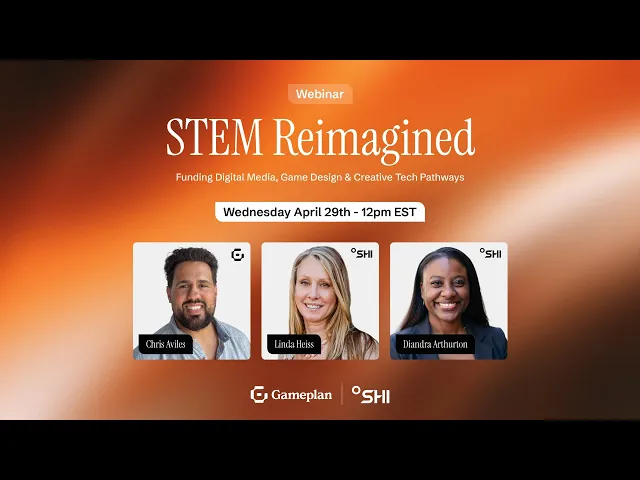
In our webinar with SHI, we break down how schools can think about funding creative technology pathways across curriculum, equipment, certifications, and professional development.
Watch the webinar here:
Want help thinking through the right fit for your school or district? Schedule a 15-minute meeting to talk through program options, funding alignment, and next steps.
FAQ’s:
Can STEM funding be used for game design programs?
Yes, but schools should connect game design to clear outcomes such as computer science, design thinking, digital arts, technical skill development, portfolio creation, and certification preparation.
Can CTE funding support media production courses?
Yes. Media production can align with CTE pathways connected to broadcasting, audio/video technology, digital storytelling, communications, marketing, and portfolio development.
What funding sources can schools use for cybersecurity programs?
Schools may be able to use CTE funding, STEM grants, workforce development funding, technology grants, after-school funding, and certification-related funding depending on the program structure and student outcomes.
How should schools write grant language for creative technology programs?
Schools should lead with outcomes instead of tools. The request should explain what students will learn, how the program supports district goals, and how success will be measured.
Why separate funding for curriculum, equipment, certifications, and professional development?
Separating these categories makes the funding request clearer. It helps schools match each cost area to the most appropriate funding source and makes the request easier for reviewers to understand.
Written by

Chris Aviles
Chris Aviles is the Product Evangelist at Gameplan and the founder of Garden State Esports. A passionate educator and pioneer in scholastic esports, Chris has revolutionized the educational landscape by integrating esports into schools. His book, The Esports Education Playbook: Empowering Every Learner Through Inclusive Gaming, reflects his commitment to using gaming to enhance student engagement and learning. Under his leadership, GSE has become the largest scholastic esports league in the U.S., fostering teamwork, leadership, and inclusivity among students. At Gameplan, Chris continues to advance his mission of expanding esports opportunities in education.